Showing posts with label Music Video Post Production. Show all posts

Monday, 9 April 2018

Final Edit of Our Music Video

Here is the final edit of our music video:


I am extremely pleased with the completed version of our music video, and I believe the quality is demonstrative of all the hard work that was carried out by the group. Despite experiencing problems and set-backs throughout our production process, I think that our final product highlights that we were able to combat the issues we faced effectively. Our ability to work efficiently and creatively as a team is evidenced by this piece, via the range of cinematography and editing techniques that are included.

Wednesday, 28 March 2018

Goodwin's Theories: Our Video

After carrying out research into Andrew Goodwin's theories at the beginning of this process, we kept them in mind throughout the completion of our music video. We thought that it would be valuable to reflect on the ways that our video does/does not conform to Goodwin's theories post the completion of the final draft of our video. Unfortunately, Caitlin was unable to attend on this day to contribute to the discussion. 


In our music video, we used Goodwin's concepts of illustration and amplification, and we did not touch upon the concept of disjuncture.

After filming this video, I realised that we had only touched upon one area of Goodwin's theory; whether the lyrics of the song matched the visuals of our music video. We had, in fact, not discussed genre conventions, the visuals matching the music, star representation and voyeurism/'the notion of looking'.

Genre conventions: I believe our video conformed to Goodwin's theory of genre conventions partly, as there are many indie/alternative music videos that are narrative music videos. An example of this is the music video for "If They Only Knew" by Alfie Arcuri:


However, we did not include lip syncing in our video, which are common features in music videos of the indie genre. We decided that we did not want to include lip syncing, as we wanted to focus more heavily on the narrative of our piece. Due to us tackling the topical issue of LGBT+ relationships in our narrative, we wanted the video to solely focus on this, to highlight its importance. We felt that including lip syncing would be including it when it was not necessary, and we felt as though it would not add any value to our video.

Visuals matching the music: I believe our video did conform to this element of Goodwin's theory, as I believe that the visuals of our music video did match the music. Particularly towards the end of the piece, beginning most prominently during the argument scene, the shots in our music video are fitting to the chosen song. In the argument scene, Hannah intentionally lined up the footage where her arms rise, to coincide with the lyric "maybe". Additionally, in the montage of the shots of Jade and Hannah, it was closely edited to make sure that the shots transitioned on the beat of the song. We also managed to subtly line up movements of the characters heads and eyes to comply with the beat/rhythm of the song. We focused more on this in the second half of the video, as it helped with the build up of the narrative, as it added more of an impact to the section due to it being more pleasing to the senses of the viewer.

Star representation: We did not conform to Goodwin's theory of star representation, as we did not have a celebrity/well-known individual in our music video. It was not featured in our video in any way; not through costume, movements or appearances.

Voyeurism/'The notion of looking": I do not believe our music video includes any voyeuristic treatment/objectification of women, so it does not conform to this aspect. Voyeurism would have had no contribution to the narrative of our video, and therefore, it was unnecessary for us to use this. Additionally, as it was a piece created for school, we did not feel voyeuristic features would be appropriate. 

However, our piece does conform to "the notion of looking", as we include multiple shots of Hannah looking at herself in the mirror. The mirrors, and filming the protagonists in them, are representative of the notion of looking.


Sunday, 25 March 2018

Changes to Our Plans

Throughout the production process, there were a number of our original plans that we had to change, for a variety of reasons. In this post, I will outline the changes that were made, with justification as to why. I will also make comments in reference to our contingency plan.

The Boyfriend

At the beginning of the production process, it was planned that Rhys Jones would play the role of the boyfriend of the protagonist in our music video. However, before we started filming, Rhys broke his leg, which meant he was no longer able to be featured. As a result, we had to find another person suitable for the role, and we picked Josh East. Thankfully, this incident happened before we had begun filming, as this meant that we had not wasted time collecting footage that we would be unable to use. Instead, the whole process would start as it was meant to, but just with Josh taking Rhys' place in our cast.

The Song

During the editing process, we discovered that the footage we had filmed was not very suiting to the song that we had initially chosen, which was 'W.D.Y.W.F.M?' by The Neighbourhood. Due to a lack of resources, equipment and budget, we were unable to create the correct aesthetic that we wanted to achieve for the piece, to fit with that song. This forced us to go back to the drawing board, as we knew that if we stuck with our original song, then our final piece would not be of a good standard, and our group would feel unsatisfied. We needed to find a new song that fitted with our original narrative, was of the 'alternative' genre, and that would go with the footage that we had already collected. After consideration and exploration, we identified that 'Sorry' by Nothing But Thieves would be perfect, as it did all of those things.

Narrative

Changing the song that we were going to use for our music video meant that we would need to alter the way in which we would portray the narrative, and also alter the narrative very slightly. Our original plan was that Hannah's character, the protagonist, would not actually get into a relationship with her best friend (the one she falls in love with). However, with the change of the song, such a heavy focus on the protagonist's emotional trauma did not feel fitting. As a result, we decided that we would change the ending of our piece to include the build up of the two female characters actually getting into a relationship. We thought that this more positive ending fitted better with our new song, and we wanted the narrative to follow similar to that of Todorov's narrative theory; equilibrium, disequilibrium, then return to equilibrium. We also thought that this would give a more optimistic message for the LGBT+ community, as it demonstrates that self-acceptance and embracing who you are is a positive thing. It also provides important representation of the LGBT+ community, which is important considering there remains a societal taboo, and prejudices, around this. It highlights how someone can be negatively affected by feeling that they have to hide who they, and feeling scared to express themselves, because of these remaining societal issues.

Changing the narrative, though only slightly, meant that it was necessary for us to think of new filming locations for the shots that we wanted to achieve. We decided that in order to effectively portray the contrast of the unhappiness that Hannah's character felt with her boyfriend, compared to the happiness that she experiences with Jade's character, that we needed to show a direct comparison. In order to do this we mostly chose locations to film that were the same, or similar to those that we filmed with Josh. This would allow us to replicate shots, but with Hannah looking happier with Jade, allowing the audience to draw a direct comparison. Here is an outline of some of the filming that we needed to complete after making this change:


Props

After we changed the song for our music video, we did have to alter some plans in terms of the narrative. This had an affect on the props that we would be using. With our initial song choice, we had the need to use cigarettes and fake drugs as props, to emphasise the mental trauma. However, we did not feel that the tempo of the new song we had chosen called for these props to be used anymore. We decided that shots of alcohol and drinking could reflect themes of emotional trauma and declining mental health due to self-conflict efficiently.

Filming Schedule

We were unable to adhere to our initial filming schedule for a variety of reasons, meaning our contingency plan had to come into place here. With rota's for our group members jobs being released sometimes only days before their shifts, we were forced to have to reschedule a lot of our filming sessions. This meant that the date we would complete filming got pushed further back than we would have liked.

One of the members of our group moved house during our production process, which meant they were largely unavailable for filming for a period of time. As this individual played the protagonist in our piece, we could not film without them, which added a further delay to our filming. This was unable to be fixed with a method similar to one in our contingency plan, as there was no solution. We could not film without Hannah, and therefore, we had to try our very best to make ourselves free whenever she had a little period of availability, to try and get us back on schedule.

Though we did not finish filming for our piece until a later date than we had initially planned, we were still able to start our edit with the footage we had already obtained. This meant that we did not fall behind that much in terms of our project timeline.

The weather did have an affect on our filming, mostly having an impact on filming that we needed to complete at the beach. When considering weather, we had not considered that high levels of coastal wind would make filming difficult. However, when we made the first trip to the beach to attempt to film with Jade and Hannah, the wind was so strong that we were unable to film certain shots that we had planned, due to their hair blowing in the wrong directions. To try to combat this, we filmed all the footage we could on this occasion, and scheduled to return to the beach on a less blustery day. We returned to the beach a few days later, as there did not seem to be much of a breeze that day. However, the wind was strong when we had reached the coast, so we were faced with the same issue. This meant that we had to improvise in terms of shot ideas, and how we could create the same affect, by using different shots. In my role as director, I instructed these changes, and attempted to find ways that we could still gather shots to shape our narrative, that did not show how windy the weather conditions were, as this would have looked unprofessional.

Editing Software

As I have outlined in my posts based on editing, we were forced to switch editing software after we had begun editing, due to regulation problems stopping us fro being able to attend the location in which we were using their facilities. We had to switch from Adobe Premier Pro, to iMovie, which although meant regressing in terms of the complexity of the software, it meant that we were able to use it more easily. Subsequently, we believe that having to alter the editing software we were using was very beneficial to us as a group, as it allowed us to make full use of the features available to us on software that was easier to navigate.

Saturday, 24 February 2018

Editing: iMovie

We transitioned from using 'Adobe Premier Pro' to iMovie, and though it happened for regulation reasons out of our control, it actually proved to be extremely beneficial to our group and our final product. The process of editing became much more efficient, as we had access to iMovie at school and at home, and we did not have to travel back and forth to the college in order to edit. Eliminating the need for travel for our group was very beneficial as none of us are able to drive, so we were relying on lifts there, which meant we had to accommodate our editing time around other people's schedules. Having access to the editing software both in school on the selection of macs that are available, and on my laptop proved useful. It meant that during any free periods in school, we could access our edit to work on it. Having the software on my laptop also meant that I could spend multiple hours outside of school hours editing, which proved essential in us being able to edit our final draft with such precision as we did.


Although our group had experience in using Adobe Premier Pro, we still found that it was very complicated to get to grips with. We had found that time that could have been spent editing was being spent trying to figure out how to use certain tools and effects. As a group, we found that iMovie was a much more simple piece of software to use. Hannah and I had previous experience in using the software, which meant that we were aware of most of the features it had to offer, and could use them effectively.

What tools/techniques did we use?


We used the crop to fill tool to turn this relatively long shot of Hannah and Jade into a medium shot, as we felt that this would be more effective in the piece. Making the shot more focused on the girls highlights their emotion, and removes the unnecessary background that was included.


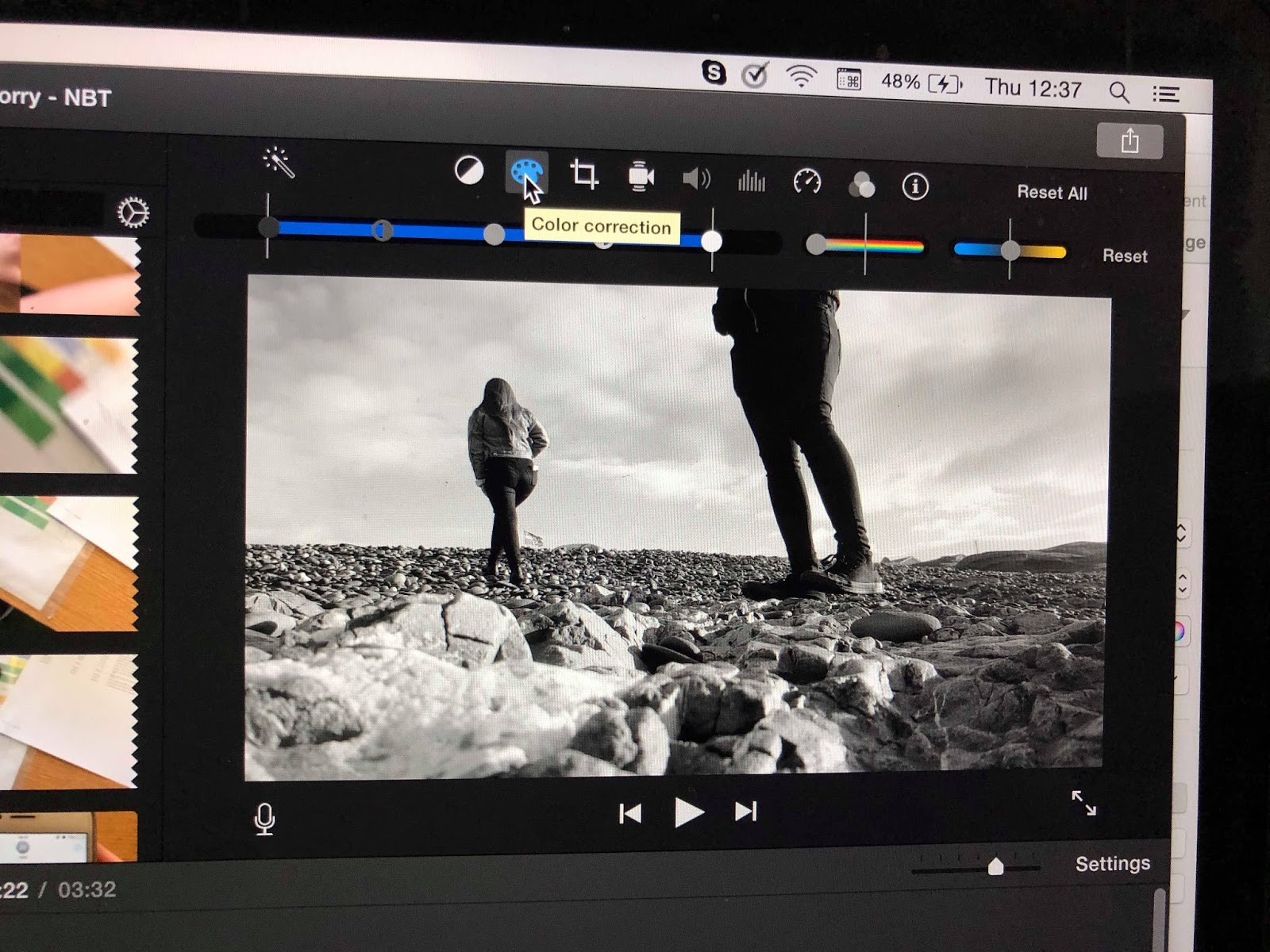
When using iMovie, we were unable to use techniques such as isolating colour within a shot, as the software was not capable of advanced techniques such as this. Instead, we used a split between a black and white filter on shots, and standard colour on the rest of the shots, to demonstrate the protagonists transition between self-conflict, sadness and isolation, to happiness and acceptance of her sexuality. To create the black and white filter effect, we used the colour correction tool to erase the colour and leave the shot in black and white.


Throughout the video, we used the slow motion technique on a multitude of occasions. We felt that slowing down the clips to 80% of their normal speed helped to make them more poignant, and added to the emotion of the shots. In coloured part of the piece, we used slow motion as a method to make the shots seem very dream-like, as we wanted to represent the protagonists relief and intense happiness that she had finally accepted herself, and was falling in love again.


Cross dissolve with slow motion
Cross dissolve with increased speed


In our piece we featured sections of footage where we used cross dissolves. This was a technique we were unfamiliar with before this project, but we thought that using cross dissolve techniques worked almost like time lapse in a certain sense. We used a cross dissolve of Hannah and Josh walking on top of the rocks to represent sadness and how time moved slowly because the protagonist was so unhappy. We also used a cross dissolve in the reversed shot of Hannah walking on the pebbles away from Josh, to demonstrate the speed of her return to him, as she could not bring herself to let go.


We used the stabilisation tool on this long shot of Jade and Hannah at the beach, as due to the strong wind that day, the footage was a little shaky. The stabilisation tool proved to be quite effective, as it zoomed in on the shot more to decrease its shaky appearance.


Opinion on using iMovie...

I believe that switching to using iMovie was the best decision we could have made for our the editing process of our video. Our familiarity with the simple software allowed us to edit the footage a lot better than we would have using 'Adobe Premier Pro'. We could make full use of the software and its features, and for that reason, I believe our final edit is of a much better standard than we would have been able to produce using the more complicated software.

Tuesday, 20 February 2018

Music Video: Our First Draft

Here is the first draft of our music video:


Feedback...

We asked for feedback on our first draft from our media teacher and our peers. As a group, we would reflect on their comments after watching our first draft, and then we would go back to the editing process in order to attempt to improve our piece, with the improvements made based on the feedback that we received. Obtaining feedback is also a good way for us to be able to find out what people like about our video.

Here are some of the comments we received:

"The opening shot is effective in portraying the mood and isolation, but there needs to be some sort of sound paired with the track, whether diegetic or non-diegetic."

"The argument scene is very effective. The order of shots and the way the footage is edited on beat creates a very professional feel to this sequence."

"I think the way the title comes in is very effective, as is the size of the names in comparison to each other. However, I think that the font is a little too curly for the alternative genre of music."

"The final sequence in which the relationship between the protagonist and the other female character is developed is organised in a way that tells the narrative effectively. My suggestion to improve the sequence further is to edit the sequence more closely on the beat. This would be very visually impressive for the audience."

"Some of the shots are a little unstable, so the piece would look more professional if the shakiness could be minimised"

"Some of the shots could be more effective if they were in slow motion"

When considering the feedback we were given, these are the improvement points that we can initially see to make:

  • Look for a different font for the titles. We can do this on the video editing app, as we want to keep the size and introduction of the titles the same.
  • We will add the diegetic sound of the sea over the opening shot because this will make sure the audience do not lose interest.
  • We will revise the sequence of shots that are at the end of our piece. We will keep their order the same, however, we will edit them so the movements of the people within the shots coincide with the beat. We will also edit the sequence so that the shots change on the beat, too.
  • We will use the stabilisation tool on iMovie in order to stabilise the footage that appears shaky
  • We will experiment with using slow motion to extend certain shots, in order for them to have more impact

What changes will we make based on what we think?
  • We will alter the order of the footage before the argument scene, to attempt to make sure the narrative is more clear.
  • We will remove the scenery shot, as it does not appear to have any relevance to the narrative and seems pointless.
  • We will add the black and white effect to all of the footage prior to the shot of the Hannah deleting the photo of Josh, as a means to demonstrate how Hannah is much happier once she learns to embrace her sexuality.


Wednesday, 13 December 2017

Editing: Adobe Premier Pro

Editing Day 1


Location: Bridgend College
Date: 12/01/2018
Group members present: Hannah Martin, Jade Dibble and Caitlin Elward


Unfortunately, I was unable to attend the first editing day with my group due to commitments for one of my other A Level subjects. However, I was briefed by my group on their return to school about what they had done, and they had shown me a clip of what they had put together.

The software that we will be using to edit our music video is 'Adobe Premier Pro' which, as a group, we have previous experience using. We used this software to edit our AS thriller opening sequence, and therefore, we could work this software to use very basic editing techniques. We employed the help of one of the editing experts at the college to instruct us on how to use some of the more complicated editing features, and we hope to be able to use them in our piece. For example, we were instructed on how to isolate a single colour in a shot, which we thought could effective in terms of highlighting our protagonist's emotional struggle.

The first editing session primarily involved creating a basic foundation of the video, by ordering the shots in the timeline of the programme. They used this session to cut down footage, so that only the shots that we needed were selected. This was a time consuming job, due to having ample footage, and multiple takes of some shots, to ensure we had choice when it came to editing. Due to the amount of footage we had acquired at this point, they found that it took quite a while to import it all onto the mac that they were using to edit on.

The basic outline of the order of shots that was created acted as a guide for us to evaluate what footage we needed to obtain in future filming sessions if it was necessary. It also provided a template that we could experiment with, and if we were not happy with the changes we made, we could revert back to this to reconsider how we would work to alter and improve it.


Further Editing on Adobe Premier Pro...

We visited the college on one further occasion after our first trip, in order to make more progress in the editing of our piece. However, we were told shortly after our second visit that we would no longer be able to visit the college to use their facilities due to health and safety issues, and lack of completed risk assessments. This proved to be a challenge for our group, as none of us owned the 'Adobe Premier Pro' software, so we could not carry on editing using this. We were forced to find different editing software that we had access to, in order to complete the edit of our music video, so we decided we would transition to iMovie. The need for transition prompted another issue for ur group, which was that we were unable to convert our current draft of the video from a Premier Pro file to one that could be edited on iMovie. This meant that we had to start our edit from scratch again, which was a set back to us. Thankfully, we had exported our draft as an MP4, so we could view what we had edited so far, and we were then able to follow this as a template to recreate it on iMovie.